Saturday, January 14, 2012

Does democracy help or hinder the economic growth?


 In his talk Yasheng Huang (2011) is speaking about the economic growth in China and India. I was interested in this topic because he raised a question which is very interesting for economists, as for me. The key question of the talk is “whether democracy has helped or has hindered the economic growth?”
  First of all as this question was very interesting for me, especially I wanted to understand why and how China grows so fast, I have decided to search also about Yasheng Huang for understanding whether it is a trustworthy source or not, and I have found out some details about the author. 
 Yasheng Huang is a professor of political economy and international management at MIT Sloan School of Management. His previous appointments include faculty positions at the University of Michigan and at Harvard Business School. He was also a consultant to the World Bank.

The key question in this topic, which also includes the main idea, is “why has China grown so much faster than India?” For answering to this question Huang uses many statistical data and historic evidences of China and India by making several comparisons mainly in terms of GDP growth rates. According to those statistical data China has grown twice the rate of India during the last 3 decades. For explaining such kind of result Huang uses “The Shanghai model of economic growth”, which consists of several characteristics that foster the economic growth:

  •   Infrastructures
  •         Strong government 
  •         State capitalism and government ownership
 The main point of this model is that the democracy is the hindrance for economic growth rather than a facilitator of economic growth. Another important question comes up here: “how important are infrastructures for economic growth?” By using two examples (the first example is that Soviet Union had more telephones than China, and the second is that India had longer system of railways than China till 1990s) Huang came to conclusion that infrastructure doesn’t explain why China has grown faster than India. Even if Soviet Union had more telephones, the country collapsed, that means that infrastructure doesn’t help to economic growth. India being a smaller country than China had longer railways, but again China today has great economic advantage over India. If we look at the evidence worldwide, we can say that infrastructures are the result of economic growth rather than the cause for economic growth.

 The important question is also: “Is democracy bad for growth?” The author compared the GDP rates per capita for India and Pakistan. India is democratic country, Pakistan is a non-democratic country. The comparison of these 2 countries is more convenient and acceptable than India and China, because India and Pakistan are similar from the geographic point of view; also they have somehow common history and culture. The only common thing among India and China is the highest population. Again when we look at the statistical evidence worldwide, there is no support for the idea that authoritarian governments hold a systematic advantage over democracies in terms of economic growth.
So, for answering to the main question let’s compare China during Cultural Revolution with India during the times of Indira Gandhi. During Cultural Revolution China’s GDP rate was by average about 2.2% larger than India’s GDP rate. This means that China had one important and advantageous resource which helped the country to overcome the worst effects of Cultural Revolution and that resource was human capital. At the same time the adult literacy rate in China is 77%, the same rate in India is 48%. Here the key issue is to understand how the literacy rate is defined in both countries. In China literacy is defined as the ability to read and write 1500 characters. In India literacy is defined the ability to read your own name in the language you happen to speak. The reason of this advantage is discrimination.

 The important issue is also the political system of China. Let’s consider statics of the political system and the dynamics of the political system of China. Statically China is a one party system, authoritarian. Dynamically, it has changed over time to become less authoritarian and more democratic. In terms of the political changes they have introduced village elections, they have increased the security of proprietors and the security with the long-term land leases, and there are also financial reforms and rural entrepreneurial revolution in China. In the case of India the country has undertaken not only economic reforms, but also political reform by introducing village self-rule, privatization of media, and introducing freedom of information acts.


  By summarizing the main perspectives of this topic, let’s compare dragon and elephant:” Which country has the growth momentum?” China has some of the excellent raw fundamentals (mostly the social capital, the public health), that we cannot find in India. But from the other side India has the momentum; it has solid institutional conditions for growth. India has the right institutional conditions for economic growth whereas china is still struggling with political reforms. The main idea that Huang states here is that for keeping the economic growth, political reforms should happen in China.

 Overall the topic is very interesting. The author clearly defines the issue and uses many statistical data and examples for his explanations. He uses question-answer type of presentation by which he presents several questions in the same talk. At the end of his talk Huang states his assumption and point of view. Logical explanations are provided in this talk. The author talks clearly, and precisely presents the evidence and perspectives. 
Source: Huang, Y. (2011). Does democracy stifle economic growth? TEDTalks (video podcast). Retrieved from: http://www.youtube.com/watch?v=UR-uWwvpn5c 

Wednesday, December 28, 2011

Don't Regret


 Kathryn Schulz is talking about regrets, their components and how to leave them. As a good example she presents the example of tattoo, which is very a common problem for nowadays among young generation (so is for me, as one of my dreams is to make tattoo).  People mostly want to make tattoos up to 25 ages, but some part of them after having it, after age 30 regret about that. 
One of the most important issues here is to understand what     means “regret”. So let’s consider the question: what is “regret”?                                                                    
 It is some kind of feeling about the current conditions and situations that they would be better, if we have done some actions differently in the past. There are 2 important things for regret. First one is decision: to be sure that you are ready and want to do that. And the second one is imagination: to feel and understand into what that decision will lead in the present. We often feel regret when we think we are responsible for decisions results of which were badly but almost were good. The example of such regret is being late for the train or airplane for 5 minutes and 25 minutes. In the case of 5 minutes we regret more than in the case of 25 minutes.
 Researchers found out the answer to the other important question: what do people most regret in life? Among top 5 regrets are education (32%), career (22%), romance (15%), parenting (10%) and self (5.47%). All these we know about regret come from finance, but in life there are many other regrets that are not classified by finance. 
In psychological terms there are 4 components of regret:
  •         Denial (make it go away)
  •     Bewilderment (How could I have done that?)
  •      Punishment (correct herself/himself)
  •     Perseverations (continuously think and look at the same thing).

But according to Schulz, 1 more component exists, which she called “wake up call”.
 There are 3 things that help us to leave regret. First of all is to take some comfort in universality, the second way of leaving regret is to laugh at ourselves, the third way is through passage of time. Some of personal regrets are not as bad as we think they are.


“If we have goals and dreams, and we want to do our best, and if we love people, and if we don’t want to hurt them or lose them, we should have feel pain when things go wrong. The point isn’t to live without any regrets; the point isn't to hit ourselves for having them. We need to learn love the flood of imperfect things that we create and to forgive ourselves for creating them. Regret doesn’t remind us that we did badly; it reminds us that we know we could do better”. -- Kathryn Schulz

Tuesday, December 20, 2011

The Story of Stuff

 I received the link of this youtube video from my instructor of Natural Resource Economics and Environmental Protection subjects. That is a very informative and interesting video. 
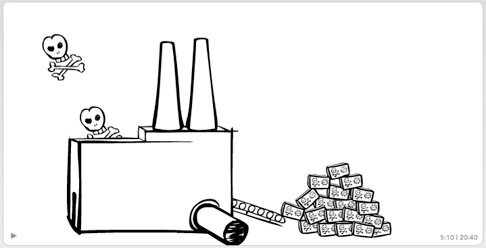
 In this video Annie Leonard is talking about the Materials Economy, which consists of 5 parts: extraction, production, distribution, consumption and disposal. By looking more deeply to this system, we can find out that some important parts are missing: “the system in crisis”. Each step of the system relates to the cultures, economies, societies and the environment which face limitations. The most important component which is unseen in this system is people who are included in all 4 parts through the system. 
  How does this system work in reality?
 Extraction: we cut trees, mine metals, use more water, danger animals. The first limit we face here is that we overuse the resources. USA has 5% of the world’s population, but they use 30% of world’s resources, and create 30% of world’s waste. If everybody consumed in such proportions, we will need 3-5 planets, but we have only 1. The result of this limitation is the use of others' land in the same way.

 Production: Toxic products are produced with the use of energy and toxic chemicals, which are having health impacts. Food is one of the vulnerable chains of getting toxins. Babies are getting those toxics from the breast feeding, because most of women which are in need are working in the factories in the reproductive ages. As a result not only materials are flowing to the production sector but also people, who have no other alternative, move to cities for finding any kind of job, no matter how toxic it is. Those toxics leave the production either in the form of products or in the form of pollution.
 What happens with all natural resources after they become a product?
 
Distribution: It describes the sales of toxic products as soon as possible with low prices. The purpose of distribution is to make people to continue buying. It’s all about externalized costs: real costs of making different products are included in their prices. But in fact we see that the price doesn't show the real production cost of products.

 Consumption: This is the most primary and important part of the system. Consumption keeps the flow of resources along the system. Consumption or shopping is the only seen part of Materials Economy, the rest processes – the extraction, production and disposal- happen outside of the field of vision.
 What does happen with all those products we buy? The answer to this question is:
Disposal
: The trash either goes to the land field or is burned. In both cases there is pollution of air, land, water, which results to climate change.  Burning the toxins will create new super toxins like dioxin. For not creating dioxin, we should stop burning trash, and for that one of the best ways is recycling. It decreases the number of trash, but for some reasons recycling isn't enough, because there are some garbage’s which can’t be recycled.  

 According to Annie, this problem can be solved only when people, involved in this system, join together and make this system to become new one without wasting resources and people, which is based on “sustainability, equity, no waste, renewable energy, closed loop production”.

Sunday, December 11, 2011

How to learn from mistakes?


 According to Diana Laufenberg, the learning process has to contain several educational failures. In the 20th century the main sources of information and learning were teachers and books bought by people for self-education. Nowadays information is available through the internet and the students should understand how to use it properly for getting the knowledge. During working in different states Diana has used her style of teaching which is allowing students to work individually and by team, to find the ways to get the needed information and to use the acquired information in a right way. This teaching system helps to develop students, it also allows the students to do mistakes, have failures and learn from their own mistakes.